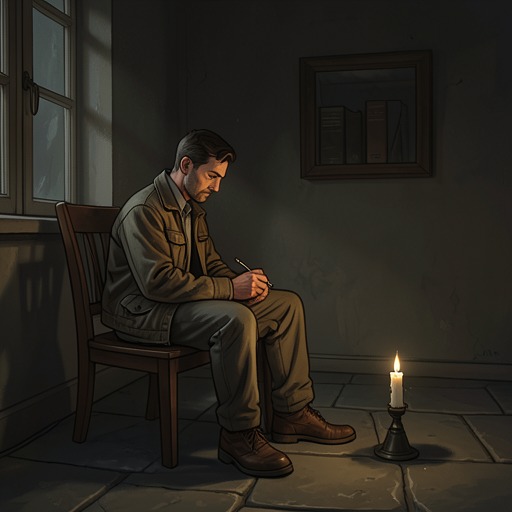
Mikael Blomkvist's libel conviction and imprisonment
The Girl with the Dragon TattooMikael Blomkvist's libel conviction and imprisonment is the decisive public and professional setback at the beginning of his story: a court rules that he libelled and defamed financier Hans-Erik Wennerström, imposing three months in prison and 150,000 kronor in damages. The judgment strips a careful investigative journalist of his credibility, burdens the fragile magazine Millennium, and creates the crisis from which his later work emerges.
Conviction and Public Disgrace
The trial concludes with Blomkvist accepting the judgment rather than appealing. He tells reporters that he regrets the court did not reach another conclusion and refuses to apologise to Wennerström or shake his hand. When asked whether he still considers Wennerström a crook, he avoids repeating the claim on the courthouse steps, recognizing that doing so could create a fresh legal problem. His formal statement is restrained: he believed he had good reason to publish the information, but the court had ruled otherwise and he accepted that the judicial process had run its course.
The restraint does not erase the humiliation. Blomkvist had never previously faced a criminal charge, and the conviction is legally minor when compared with armed robbery, murder, or rape. Its symbolic force is nevertheless large because his profession depends on the authority to investigate, verify, and publish. The verdict presents him as a journalist whose confidence in his evidence exceeded what the court would accept.
Financial and Institutional Consequences
The damages are personally severe. Blomkvist is both a part owner of Millennium and, in what he recognizes as an awkward arrangement, both its writer and publisher, so he must pay the 150,000 kronor himself. The sum nearly wipes out his savings. Millennium covers the court costs, but the magazine barely breaks even and has no unlimited resources to absorb a major legal defeat. Prudent budgeting may keep the crisis from becoming a catastrophe, although Blomkvist even considers selling his apartment, an attic flat of about 700 square feet on Bellmansgatan that he had bought inexpensively after searching for a permanent home during the prosperous late 1980s.
The conviction also weakens the magazine's public position. Later discussion of Blomkvist's character emphasizes that his previous controversial revelations had been carefully documented, making the judgment appear inconsistent with his established practice. Dirch Frode observes that Blomkvist seemed to have surrendered without a fight, something that did not accord with the image of a careful reporter. Frode can only speculate that Blomkvist either trusted a source who was wrong, was deliberately fed false information, or faced a threat so serious that he preferred to be seen as an incompetent rather than resist.
Imprisonment at Rullåker
Blomkvist enters Rullåker Prison with a sentence of three months but is released on Friday, May 16, after serving two months. He had applied for parole on the day of his admission without much hope. He never fully understands the technical basis for the reduction; possible factors include his decision not to use holiday leave and the prison's overcrowding, with forty-two inmates for thirty-one beds. The warden, Peter Sarowsky, a forty-year-old Polish exile who gets along well with Blomkvist, recommends that the sentence be shortened.
The prison experience is unexpectedly calm. Rullåker was designed, in Sarowsky's description, for hooligans and drunk drivers rather than hardened criminals, and its routines remind Blomkvist of a youth hostel. Other prisoners regard him as an unusual figure because he is the only inmate to appear on television news, a fact that gives him a certain status. On his first day he is offered therapy, Komvux training, adult education, and occupational counselling, but he sees no need for social rehabilitation: he has completed his studies and already has a job.
Instead, he asks to keep his iBook in his cell so that he can continue writing the book he has been commissioned to produce. The request is granted, and Sarowsky arranges a lockable cabinet. The other inmates do not threaten the computer; they keep a protective eye on Blomkvist. This detail turns imprisonment from a purely punitive interval into a strange continuation of intellectual work, preserving his identity as a writer while suspending his public role.
Doubt, Investigation, and Ethical Thresholds
The conviction leaves unresolved whether Blomkvist was deceived, threatened, or simply wrong. The later uncertainty matters because he continues to believe that the Wennerström affair contains a real story. His professional disgrace therefore becomes an epistemological crisis: the central question is not merely whether he can recover his reputation, but whether the methods and sources on which his reputation rested can still be trusted.
That crisis intersects with his work for Henrik Vanger. When evidence begins connecting the Vanger family's past to the murder of Rebecka Jacobsson and to a broader pattern of violence against women, Blomkvist and Lisbeth Salander consider whether to inform the police. They decide against doing so without Henrik Vanger's approval, in part because the statute of limitations has long since expired and the police investigation was closed. The decision places private investigation, historical truth, and legal authority in tension: discovering what happened does not automatically create a viable prosecution.
Their inquiry develops a disturbing theory about Gottfried Vanger and Martin Vanger. Blomkvist concludes that Gottfried was responsible for the first series of murders between 1949 and 1965 and that he drew Martin into the crimes. Martin had witnessed the murder of Lea in Uddevalla in 1962 at the age of fourteen and actively participated in the murder of Sara in 1964 at sixteen. Blomkvist also infers from Martin's account that Gottfried sexually abused his son for a long period, presenting the abuse as a duty. The possibility of an abusive upbringing supplies a causal history but not an excuse.
Salander insists on that distinction. She rejects the idea that Gottfried's childhood mistreatment or Martin's abuse gives either man the right to murder women. Her repeated judgment is that both men made a choice. The argument exposes a moral question that the conviction also raises in another register: explanation may clarify how violence develops, but it cannot dissolve responsibility for the acts themselves.
Release and Return to Journalism
After his release, Blomkvist's professional future remains uncertain, but Henrik Vanger's letter gives him a route back to independent work. Vanger expresses respect for Blomkvist's integrity, refuses to tell him what to write, and promises not to exert pressure. The contract remains valid if Blomkvist wants to continue, and he has enough material to finish the chronicle of the Vanger family. The offer restores neither the lost verdict nor the damaged reputation, but it protects his freedom to investigate and publish.
The later Wennerström investigation reveals why the earlier conviction does not settle the truth of the affair. Millennium eventually finds a source inside Wennerström's circle, a frightened Deep Throat who can meet only in hotel rooms. The source reports that money from the Minos affair financed weapons deals during the war in Yugoslavia and that Wennerström dealt with the right-wing Ustashe in Croatia. Copies of documents support the allegations. The new material converts the old disgrace into an unresolved challenge to the court's version of Blomkvist's failure.
Lisbeth Salander's role makes the ethical problem sharper. She obtains unlimited access to Wennerström's computer and also hacks the computers of several lawyers and close associates. Erika Berger's immediate reaction is that Millennium cannot use material acquired illegally, while Blomkvist argues that the magazine need not reveal how it obtained the files and could present them as material supplied by a source with access to Wennerström's computer. The episode does not erase the legal and moral ambiguity; instead, it contrasts formal journalistic legitimacy with an illicit method that may uncover evidence the legitimate channels failed to expose.
Narrative Significance
The conviction and imprisonment function as both punishment and narrative reset. Blomkvist loses money, status, and temporary freedom, but prison does not reform him into a different person or end his investigative vocation. He writes there, leaves early, and accepts work that requires him to confront a buried crime and the limits of official investigation. His apparent defeat thus becomes the condition under which he can pursue a story outside the immediate pressures of the Wennerström conflict.
The state also establishes the book's central tension between truth and proof. Blomkvist's established caution makes the conviction look anomalous; Salander's later hacking produces material whose significance may be great but whose acquisition is illegal; and the Vanger investigation uncovers crimes that the statute of limitations places beyond ordinary prosecution. Across these situations, journalism is forced to negotiate public interest, source protection, evidentiary reliability, legality, and the risk of harming others. Blomkvist's imprisonment is therefore not only a biographical setback but the first institutional test of the investigative ethic that governs his return.